
How to Learn Any New Skill Faster Using AI in 2026
A practical 5-step system to learn any new skill faster using AI—combining 80/20 deconstruction, Socratic practice drills, Feynman teach-backs, and mistake tracking.

- Read time
- 8 min read
- Sections
- 11
- FAQs answered
- 6
- Topic
- Research & Learning
To learn any new skill faster using AI in 2026, stop using AI as a passive encyclopedia and turn it into an interactive coach: map the vital 20% of sub-skills first, run daily 20-minute deliberate practice drills with immediate feedback, and stress-test your understanding by teaching concepts back to the model.
Most people fail to learn new skills—whether coding, SQL, conversational Spanish, copywriting, or financial modeling—because they get trapped in tutorial hell. They watch hours of videos, read endless guides, and feel productive without ever performing the skill under feedback. Modern AI assistants fix the two biggest bottlenecks in self-education: knowing what to practice next and getting instant, personalized critique when you make a mistake. Combined with a solid personalized AI study plan, you can compress months of trial-and-error into focused weekly sprints.
What You'll Need
You can build a complete AI skill-coaching loop on free plans, while paid tiers add higher daily limits, voice practice, and persistent project memory.
| Tool | Free Tier | Paid Tier | Best Role in Skill Learning |
|---|---|---|---|
| ChatGPT | Free access to GPT-4o mini / limited GPT-4o, voice mode, and file uploads | ChatGPT Plus ($20/mo) with Projects, higher voice/coding limits, and custom GPTs | Interactive roleplay, coding/math drills, and spoken language practice |
| Claude | Free daily messages with file uploads and Artifacts | Claude Pro ($20/mo) with Projects, Artifacts, and extended thinking | Socratic tutoring, code/writing critique, and building interactive practice widgets |
| Perplexity AI | Unlimited quick searches, limited Pro searches with live citations | Perplexity Pro ($20/mo) with Deep Research and expanded Pro quotas | Finding the best current textbooks, documentation, and real-world benchmarks |
| Google NotebookLM | Up to 50 sources per notebook, Study Guides, Audio Overviews | NotebookLM Plus (via Google One AI Premium / Workspace) with higher limits | Mastering official manuals, course PDFs, and certification guides |
Step 1: Deconstruct the Skill Into the Vital 20%
Every complex skill has a small core of sub-skills that unlock 80% of real-world results. Before you watch a single course, ask Claude or ChatGPT to deconstruct the skill for your exact starting level and goal.
For example, if you want to learn Python for data analysis—not web apps—say so. Ask the AI to list the 6 foundational concepts you must master first, the 3 common beginner traps to skip for now, and a realistic 4-week milestone project you can build with those basics. If you need vetted learning resources for that roadmap, use Perplexity AI to find current official docs and top-rated free courses.
Step 2: Build a Guided Feynman Loop to Close Knowledge Gaps
Reading an explanation and nodding along is not learning. Use the Feynman Technique inside your AI chat: explain a concept in your own plain words, and instruct the AI to grade your explanation ruthlessly for missing steps, vague hand-waving, or hidden misconceptions.
Ask the AI to respond in three parts: what you got right, what is inaccurate or incomplete, and one follow-up question that forces you to apply the concept to a fresh scenario. Knowing how to ask better questions to AI turns every 5-minute chat into a high-intensity tutoring session.
Step 3: Run Deliberate Practice Drills, Not Passive Reading
Shift 70% of your study time from reading explanations to doing reps. Instruct your AI coach to act as a drill generator that gives you one realistic mini-challenge at a time, waits for your attempt, and never spoils the answer early:
- Coding & Data: "Give me a buggy SQL query or broken Python function matching my current level and ask me to diagnose and fix it."
- Languages: "Roleplay as a cafe barista in Madrid. Speak only in Spanish at B1 level, keep turns short, and correct my grammar gently after each reply."
- Writing & Marketing: "Give me a weak product landing page headline and ask me to rewrite 3 versions using value-first framing, then critique each one."
When studying from dense reference manuals or textbooks alongside your drills, upload those PDFs into Google NotebookLM—see our guide on how to use NotebookLM to study PDFs and documents.
Step 4: Collect Instant Feedback and Maintain an Error Log
The fastest learners do not just practice more—they track their recurring mistakes. At the end of every practice session, ask the AI to summarize the top 2 or 3 errors you made (for example, forgetting GROUP BY rules in SQL, or using passive voice in cold emails) and turn them into a personal Mistake Bank.
At the start of your next session, paste those 3 items back in and say: "Design today's 15-minute warm-up drill specifically to test whether I still make these mistakes." Targeted correction beats generic repetition every time. You can also save your Mistake Bank as clean revision sheets using our document-to-notes workflow.
Step 5: Ship a Real Capstone Project and Get a Rubric Review
After two to four weeks of drills, prove the skill in the real world by building a concrete artifact—a working dashboard, a 5-minute spoken presentation, a deployed mini-app, or a live campaign audit. Ask the AI to act as a senior practitioner in that field and evaluate your finished work against an industry rubric before you ship it publicly.
Critically, do not ask AI to build the project for you. Use it as a reviewer, debugger, and sounding board while you do the actual typing, speaking, or designing yourself.
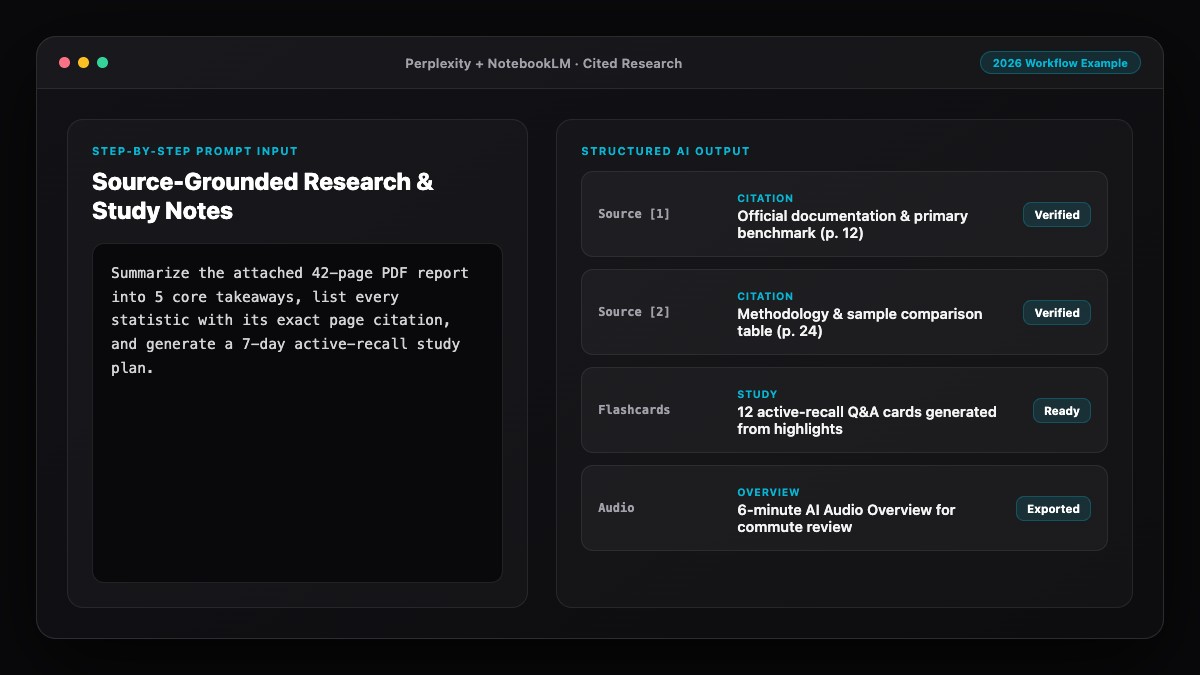
Best Prompts to Copy and Paste
Copy these three coaching prompts into Claude or ChatGPT to turn passive study into deliberate practice.
1. The 80/20 Skill Deconstruction Prompt:
I want to learn [SKILL] in [TIMEFRAME, e.g., 4 weeks] starting from [CURRENT LEVEL: beginner/intermediate].
My specific goal is [CONCRETE OUTCOME, e.g., build an analytics dashboard / hold a 10-minute conversation].
Break this skill down into:
1. The vital 20% of sub-skills that drive 80% of real-world competence
2. Topics I should intentionally skip for now
3. A 4-week sequence where every week ends with one small, verifiable mini-project.
2. Socratic Drill Coach Prompt (No Spoilers):
Act as my strict, supportive coach for [SKILL].
Give me ONE practical exercise at a time tailored to [SUB-SKILL].
Rules:
- Do NOT show me the solution until I submit my attempt
- When I reply, point out exactly what works, what is flawed, and why
- Give me a hint rather than the full answer if I am stuck
- Wait for my next attempt before moving to Exercise 2.
3. Feynman Teach-Back Audit Prompt:
I am going to explain [CONCEPT] in my own words to test my understanding.
Grade my explanation on accuracy, clarity, and missing steps.
Then ask me 2 tricky "what if" follow-up questions to test whether I truly understand how it works in practice.

My explanation:
[TYPE YOUR EXPLANATION HERE]
Common Mistakes to Avoid
- Letting AI do the reps for you: If you ask ChatGPT to write the whole script or essay, your brain skips the struggle that builds neural pathways. Always attempt first, then ask for critique.
- Staying in explanation mode too long: Asking "Explain X" ten times in a row feels smart but builds zero muscle memory. Switch to practice exercises within 10 minutes.
- Practicing without a difficulty ramp: If every drill is too easy, you plateau; if every drill is too hard, you quit. Tell the AI whenever an exercise felt too simple or overwhelming so it calibrates the next rep.
- Ignoring real-world verification: AI can occasionally teach outdated syntax or slightly unnatural phrasing. Cross-check technical methods against official docs using Perplexity or NotebookLM.
- Never tracking recurring errors: Without an error log, you repeat the same blind spots week after week.
References & Official Sources
All workflows, pricing tiers, and feature capabilities in this guide were verified against the official platform documentation:
- Perplexity AI Official Search Engine (www.perplexity.ai)
- Google NotebookLM Official App (notebooklm.google.com)
- OpenAI ChatGPT Official Platform (chatgpt.com)
- Anthropic Claude Official Workspace (claude.ai)
- Google Gemini Official Assistant (gemini.google.com)
- KwiqRank AI Workflow Integration Guide — Internal methodology for combining AI tools into repeatable business processes.
Final Thoughts
Learning how to learn any new skill faster using AI in 2026 is all about flipping the script: stop treating AI as a shortcut that replaces effort, and use it as a tireless personal coach that multiplies the return on every 20 minutes you practice. Deconstruct the vital 20%, run spoiler-free drills, log your mistakes, and ship real projects. If you are building digital or marketing skills and want to understand how modern AI engines evaluate expertise online, read our Answer Engine Optimization guide.
Your questions, answered in plain English
ChatGPT and Claude are the best interactive coaches for drills, roleplay, and feedback, while Perplexity AI helps find current official resources and NotebookLM anchors your study in textbooks or manuals.
Add explicit coaching rules to your prompt: tell the AI never to reveal the solution until you submit an attempt, and to give hints rather than full answers when you get stuck.
Yes. For spoken languages, interviews, or sales pitches, voice mode in ChatGPT lets you practice real-time back-and-forth conversations with immediate grammar and clarity feedback.
Consistent 20-to-30-minute daily sessions focused on active drills and error review outperform a single 3-hour passive video binge on the weekend.
Mistaking passive reading for competence. Asking AI to summarize concepts or generate finished projects feels productive, but real skill only forms when you produce attempts and fix your own errors.
Verify technical syntax, regulations, or current best practices using Perplexity AI or by uploading the latest official documentation into NotebookLM.
Still curious? Send us your question and a strategist will get back to you.

Want this done for you?
We can put this guide to work on your website. Start with a free audit.
Get my free auditWritten by KwiqRank Team
KwiqRank is a digital marketing agency in Mumbai, India, working with UK and US businesses on SEO, GEO, AEO, paid media and websites. We check facts against official sources, and tell you when something is unconfirmed. Spotted a mistake? Tell us and we will correct it.
Found this useful?
Get recommended by AI search
We check whether Google, ChatGPT and Perplexity can reach your pages, then fix what blocks them. No guarantees, just a clear plan.